What Plate Should I Use for My Assay?
Selecting the right microplate is a deceptively important part of obtaining reliable, reproducible optical data. Whether your assay uses fluorescence, luminescence, or a combination of both, the plate you choose directly influences sensitivity, background signal, and overall data quality.
Different plate materials, colors, and geometries interact with light in specific ways, resulting in changes in the absorbance, scattering, and reflecting of signals. These interactions can either enhance or obscure your results. Understanding how these factors affect your optical measurements helps ensure you don’t overlook valuable signals or misinterpret assay performance.
Modern multimode readers, such as Promega’s GloMax® instruments, are optimized to account for many of these factors. However, plate selection remains a key variable you control — one that can determine whether a subtle signal becomes clearly detectable or disappears in background noise.
Why Are My Signals Getting Lost?
Even with optimized reagents and instruments, cell-based assays can lose signal through several optical or mechanical factors. Below are some reasons signal can become lost:
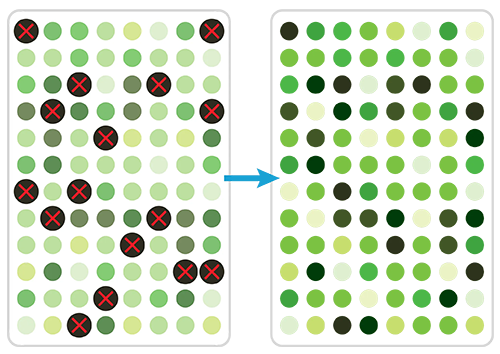
- Light Crosstalk and Reflection: This can occur when very bright wells leak signal into adjacent wells, masking signals from weaker wells.
- Saturation and Dynamic Range: In multiplexed assays, a bright fluorescent signal can overpower dimmer luminescent outputs.
- Well Geometry and Optics: Well shape and depth influence how emitted or reflected light travels toward a detector.
What Plate Should I Use for a Luminescence Assay?
Luminescence assays detect light emitted directly from a chemical or enzymatic reaction; no external excitation source is required. Because the signal originates entirely from the reaction itself, the goal is to capture as much of that emitted light as possible while minimizing any light loss or uneven reflection. Plate color and surface properties therefore play a critical role in maximizing assay sensitivity.
Recommendations
- Use opaque white plates: White-walled plates reflect light uniformly within each well, directing more emitted photons upward toward the detector. This increases the signal intensity and improves sensitivity of assays, which is particularly valuable for assays with low light output.
- Avoid clear or transparent walls: Transparent plates allow light to pass through or scatter beneath the plate, reducing apparent signal strength and increasing well-to-well variability.
Applications
White plates are ideal for:
- ATP-based viability assays (CellTiter-Glo® 2.0)
- Luciferase reporter assays (Nano-Glo® Dual-Luciferase® Reporter Assay System)
- Energy transfer assays (NanoBiT® PPI Starter Systems)
What Plate Should I Use for a Fluorescence Assay?
Fluorescence detection depends on two optical events: excitation of a fluorophore by an external light source and collection of its emitted light at a specific wavelength. Because excitation light is intense compared to the emitted signal, even small amounts of reflected or scattered light can raise background levels and obscure subtle differences in fluorescence intensity. Careful plate selection helps ensure that only true signal is captured.
Recommendations
- Use black plates: Black-walled plates absorb stray excitation and emission light, minimizing well-to-well crosstalk and background fluorescence. This is particularly important in assays with low fluorophore concentrations or when comparing many wells with small signal differences. Plates made from low-fluorescence plastics also aid in reducing autofluorescence.
- For imaging or bottom-read assays: Select black plates with clear bottoms. The clear base permits excitation and detection through the bottom—ideal for live-cell imaging or adherent-cell assays—while the black walls maintain sidewall absorption to prevent lateral light interference.
Applications
Black plates are ideal for:
- Cytotoxicity assays (CytoTox-Fluor™ Cytotoxicity Assay)
- BRET and FRET (NanoBRET® Nano-Glo® Detection System)
- Live-cell imaging (HaloTag® Ligands)
What Plates Are Recommended?
If you are looking for specific plates to use, suggestions for 96-well plates are listed below:
White Plates, Solid Bottom
- 96-Well Sterile Microplates (Cat.# E5650)*
- Greiner Bio-One CELLSTAR plate (Cat.# 655083)
- Greiner Bio-One CELLSTAR plate (Cat.# 655073)
- Corning® 96-well Solid White Flat Bottom TC-treated (Cat.# 3917)
White Plates, Clear Bottom
- Corning® Costar plate (Cat.# 3610)
- Greiner Bio-One CELLSTAR plate (Cat.# 655088)
Black Plates, Solid Bottom
- Corning® Costar plate (Cat.# 3916)
- Greiner Bio-One CELLSTAR plate (Cat.# 655079)
- Nunc™ F96 MicroWell™ Plate (Cat.# 137101)
Black Plates, Clear Bottom
- Corning® Costar plate (Cat.# 3904)
- Greiner Bio-One CELLSTAR plate (Cat.# 655087)
*These are not tissue culture grade plates so could only be used for applications other than cell-based assays, like ADP-Glo or Lumit.
Costar is a registered trademark of Corning, Inc. MicroWell and Nunc are trademarks of Nalge Nunc International. Optilux is a trademark of Becton, Dickinson and Company.
Products may be covered by pending or issued patents or may have certain limitations.


What Microplate Readers Work Well with Fluorescence and Luminescence Assays?
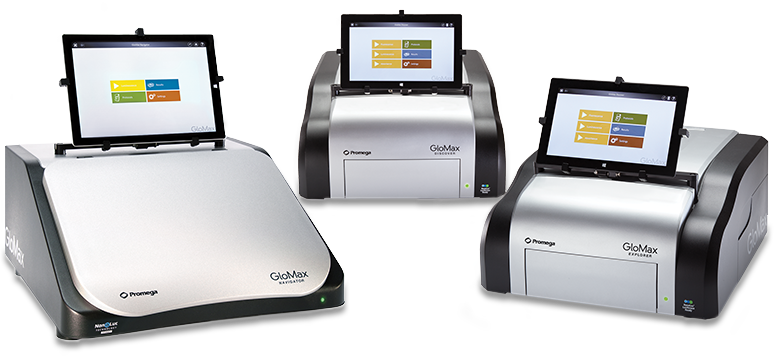
GloMax® instruments are highly sensitive, easy-to-use microplate readers with luminescence, fluorescence and absorbance detection capabilities. These high-performance instruments are offered in a choice of configurations to suit varying detection needs, from dedicated luminometer to advanced microplate reader functionality.