Mitochondrial ToxGlo™ Assay


A Cell-Based Method for Predicting Potential Mitochondrial Dysfunction
- Distinguish primary mitochondrial dysfunction from secondary cytotoxic events
- Predictive for mitochondrial toxicities
- Fast, cost-effective and easy to implement


Catalog Number:
Size
Catalog Number: G8000
Catalog Number: G8001
Predictive Data to Distinguish Mitochondrial Dysfunction
The Mitochondrial ToxGlo™ Assay is a cell-based assay method that employs a sequential addition, multiplexed assay chemistry for predicting potential mitochondrial dysfunction as a result of xenobiotic exposure. The assay is based on the differential measurement of biomarkers associated with changes in cell membrane integrity and cellular ATP levels relative to vehicle-treated control cells during short exposure periods. Cell membrane integrity is first assessed by measuring the presence or absence of a distinct protease activity associated with necrosis using a fluorogenic peptide substrate (bis-AAF-R110) to measure "dead cell protease activity". The bis-AAF-R110 substrate cannot cross the intact membrane of live cells and therefore gives no signal with viable cells. Next, ATP is measured by adding an ATP detection reagent, resulting in cell lysis and generation of a luminescent signal proportional to the amount of ATP present. The two sets of data can be combined to produce profiles representative of mitochondrial dysfunction or non-mitochondrial related cytotoxic mechanisms.
Mammalian cells generate ATP by mitochondrial (oxidative phosphorylation) and non-mitochondrial (glycolysis) methods. To achieve optimal mitochondrial responsiveness, it may be necessary to refine cell culture conditions. Replacing glucose-supplemented medium with galactose-containing medium may increase cellular oxygen consumption and augment mitochondrial susceptibility to mitotoxicants.
Mitochondrial Responsiveness to a Model Toxin in the Presence of Galactose or Glucose

Some cells treated in the presence of glucose may preferentially rely on glycolysis to meet bioenergetic needs and are therefore relatively unresponsive to mitochondrial toxins (Glucose ATP). Cells treated in the presence of galactose must use oxidative phosphorylation to generate ATP and are therefore more responsive to mitochondrial perturbation (Galactose ATP). Oligomycin treatment did not cause changes in membrane integrity in either formulation of medium (Galactose Cytotoxicity and Glucose Cytotoxicity). Shown are data from K562 cells at 10,000 cells/well in a white Costar® 96-well plate. The cells were exposed to oligomycin for 2 hours.
Mitochondrial ToxGlo™ Assay produces profiles that are consistent with mitochondrial toxicity and discernible from other non-mitotoxic mechanisms of cell death. The assay is easy to implement as it uses a simple sequential “add-mix-read” format, and assays are performed directly in cell culture plates using standard multimode detection instrumentation.
A flexible and easily automated assay, the volume of reagent addition can be scaled to meet throughput needs; the assay is amenable to automation in 96- and 384-well plates.
Representative Profiles of Mitochondrial Toxicity


K562 cells were plated at 10,000 cells/well in white 96-well plates (Costar®) and treated with serial dilutions of compounds resuspended in glucose-free (galactose-supplemented) RPMI 1640 media for 2 hours. Panel A. No changes in ATP or membrane integrity (MI) are detected, which indicates that the compound is not a mitochondrial toxin. Panel B. The reduction in ATP with commensurate MI changes indicate that the compound is not a mitochondrial toxin; instead primary necrosis is taking place. Panel C. The reduction in ATP with no changes in MI indicates that the compound is a mitochondrial toxin. Panel D. The reduction in ATP with discordant changes in MI indicate that the compound is a mitochondrial toxin.
Simple, "Add-Mix-Measure" Protocol
"Add-mix-measure" protocol is fast and easy to implement. No parallel processing in glucose-containing medium.

Protocols
Complete Protocol
Specifications
Catalog Number:
What's in the box?
| Item | Part # | Size |
|---|---|---|
|
bis-AAF-R110 Substrate |
G609A | 1 × 10μl |
|
Assay Buffer |
G610A | 1 × 10ml |
|
ATP Detection Buffer |
G806A | 1 × 10ml |
|
ATP Detection Substrate |
V363A | 1 × 1 vial |
SDS
Search for SDSCertificate of Analysis
Use Restrictions
For Research Use Only. Not for Use in Diagnostic Procedures.Storage Conditions
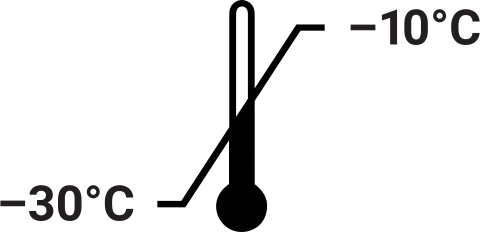
What's in the box?
| Item | Part # | Size |
|---|---|---|
|
bis-AAF-R110 Substrate |
G609B | 2 × 50μl |
|
Assay Buffer |
G610B | 1 × 50ml |
|
ATP Detection Buffer |
G806B | 1 × 100ml |
|
ATP Detection Substrate |
V363B | 1 × 1 vial |
SDS
Search for SDSCertificate of Analysis
Use Restrictions
For Research Use Only. Not for Use in Diagnostic Procedures.Storage Conditions
Related Products
Similar Products
GSH/GSSG-Glo™ Assay
Homogeneous assay to quantify total glutathione and glutathione ratios.
V6611, V6612
GSH-Glo™ Glutathione Assay
Homogeneous, bioluminescent assay to measure glutathione.
V6911, V6912
ROS-Glo™ H2O2 Assay
Sensitive, bioluminescent assay that measures the level of H2O2 in cell cultures.
G8820, G8821
Frequently Used With
CellTiter-Glo® Luminescent Cell Viability Assay
Determine the number of viable cells in culture based on quantitation of ATP present.
G7570, G7571, G7572, G7573
CytoTox-Fluor™ Cytotoxicity Assay
A single-reagent-addition, homogeneous, fluorescent assay that measures the relative number of dead cells in cell populations.
G9260, G9261, G9262
MultiTox-Fluor Multiplex Cytotoxicity Assay
A single-reagent-addition fluorescent assay that measures the number of live and dead cells in culture wells.
G9200, G9201, G9202
GloMax® Discover System
High-performance microplate reader for detecting luminescence, fluorescence and absorbance.
GM3000