P450-Glo™ CYP1A1 Assay System


A Luminescent Method for Measuring CYP1A1 Activity
- Luminescent format eliminates need for time-consuming analyses
- Broad dynamic range and low background


Catalog Number:
Size
Catalog Number: V8751
Catalog Number: V8752
The P450-Glo™ CYP1A1 Assay provides a homogeneous, luminescent method for measuring cytochrome P450 CYP1A1 activity. The assay employs luminogenic P450 substrates that are derivatives of beetle luciferin, a substrate for luciferase enzymes. The derivatives are not substrates for luciferase but are converted by P450s to luciferin, which in turn reacts with luciferase to produce light that is directly proportional to the activity of the P450.
This luminescent assay exhibits exquisite sensitivity, low background signals and broad dynamic range. It generates a "glow-type" luminescent signal, produced using derivatized luciferins as P450 substrates and a recombinant stabilized luciferase (Ultra-Glo™ Luciferase) coupled with a proprietary buffer system. The half-life of the luminescent output is greater than two hours, eliminating the need for luminometers with injectors and allowing batch plate processing. The luminescent format also eliminates the need for time-consuming analyses such as HPLC.
The luciferin-based substrates are readily taken up by cells and rapidly converted into luciferin inside the cell, which reduces the incubation time required (typically 30–60 minutes). Other benefits of the P450-Glo™ CYP1A1 Assay include a formulation that minimizes the incidence of false positives due to inhibition of luciferase by analytes when screening for cytochrome P450 inhibitors. Z´ values greater than 0.8 are achieved in either 96- or 384-well plate formats and confer highly predictive results.
Protocols
Complete Protocol
Specifications
Catalog Number:
What's in the box?
| Item | Part # | Size |
|---|---|---|
|
Luciferin Detection Reagent |
V859A | 1 × 1 each |
|
Luciferin-CEE, 5mM |
V863A | 1 × 70μl |
|
Reconstitution Buffer |
V865A | 1 × 10ml |
SDS
Search for SDSCertificate of Analysis
Use Restrictions
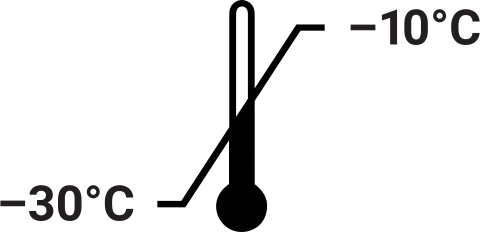
For Research Use Only. Not for Use in Diagnostic Procedures.Storage Conditions
U.S. Pat. Nos. 7,692,022 and 8,106,052 and other patents pending.
What's in the box?
| Item | Part # | Size |
|---|---|---|
|
Luciferin Detection Reagent |
V859B | 1 × 1 each |
|
Luciferin-CEE, 5mM |
V863B | 1 × 350μl |
|
Reconstitution Buffer |
V865B | 1 × 50ml |
SDS
Search for SDSCertificate of Analysis
Use Restrictions
For Research Use Only. Not for Use in Diagnostic Procedures.Storage Conditions
U.S. Pat. Nos. 7,692,022 and 8,106,052 and other patents pending.
Related Products
Similar Products
P450-Glo™ CYP1B1 Assay System
Measure CYP1B1 activity with this luminescent assay.
V8761, V8762
P450-Glo™ CYP2C8 Assay System
Measure CYP2C8 activity with this luminescent assay.
V8781, V8782
P450-Glo™ CYP1A2 Assay and Screening Systems
Measure CYP1A2 activity with this luminescent assay, or choose the CYP1A2 screening system for a complete set of reagents.
V8771, V8772, V8421, V8422, V9770
P450-Glo™ CYP2C19 Assay and Screening Systems
Measure CYP2C19 activity with this luminescent assay, or choose the screening system for a complete set of reagents.
V8881, V8882, V9880
P450-Glo™ CYP2C9 Assay and Screening Systems
Measure CYP2C9 activity with this luminescence assay, or choose the screening system for a complete set of reagents.
V8791, V8792, V9790
P450-Glo™ CYP2D6 Assay and Screening Systems
Measure CYP2D6 activity with this luminescent assay, or chose the screening system for a complete set of reagents.
V8891, V8892, V9890
P450-Glo™ CYP3A4 Assay and Screening Systems
Measure CYP3A4 activity with this luminescence assay, or choose the screening systems for complete sets of reagents.
V9001, V9920, V9910, V8911, V8912, V9002
Frequently Used With
Apo-ONE® Homogeneous Caspase-3/7 Assay
Sensitive fluorescent assay to measure active caspase-3 and -7.
G7792, G7790, G7791
Caspase-Glo® 3/7 Assay System
An easy-to-use, plate-based luminescent assay for detecting caspase-3/7 activity.
G8090, G8091, G8093, G8092
Cell-Based Proteasome-Glo™ Assays
Homogeneous, luminescent assays that measure protease activities in cultured cells.
G8660, G8661, G8662, G8760, G8761, G8860, G8861, G1180, G1200