Glycogen-Glo™ Assay
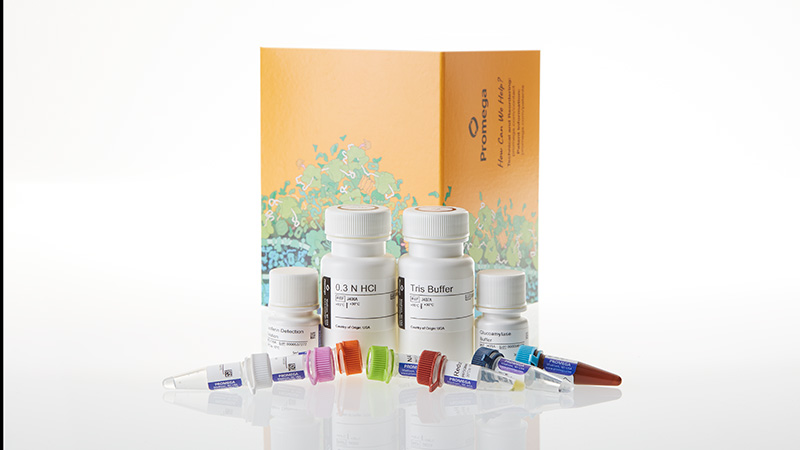
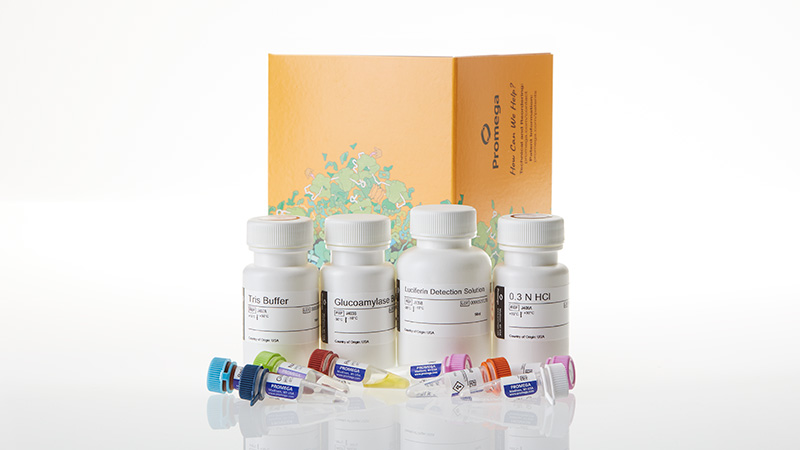
Easy, Sensitive Glycogen Assay Kit
- Compatible with cell lysates and tissue homogenates
- In-well sample preparation protocol streamlines workflow
- Scalable to 384-well plates for HTS applications


Catalog Number:
Size
Catalog Number: J5051
Catalog Number: J5052
Efficient Glycogen Detection from Diverse Samples
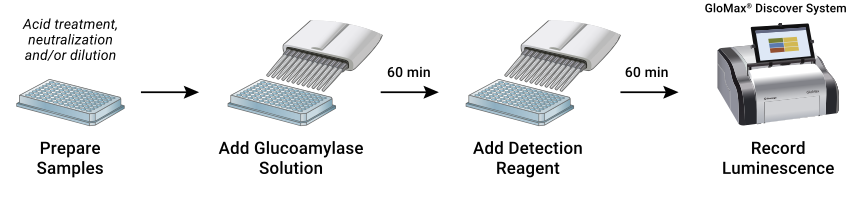
The Glycogen-Glo™ Assay is a fast and sensitive method for detecting glycogen from various biological samples, such as cultured cells and tissue homogenates. Based on bioluminescent technology, the Glycogen-Glo™ Assay can detect subtle changes in glycogen synthesis, storage and breakdown. Its streamlined sample preparation protocol involves acid treatment and neutralization directly in the assay wells, eliminating the need for cell collection, centrifugation and spin columns. The assay is adaptable to a 384-well format, facilitating quick analysis of many samples.
How the Glycogen-Glo™ Assay Works
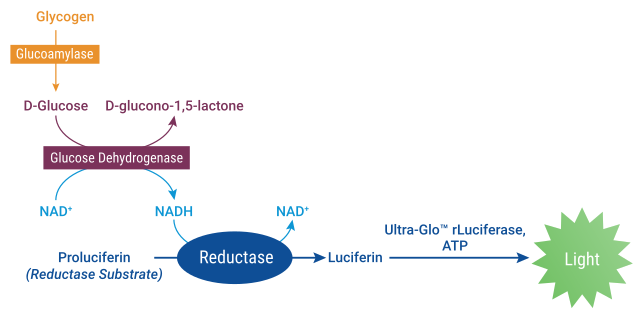
The Glycogen-Glo™ Assay utilizes a series of enzyme-coupled reactions. First, glycogen is digested into glucose using glucoamylase enzyme. The resulting glucose is measured using glucose dehydrogenase in conjunction with a bioluminescent NADH detection technology. The result is a light signal proportional to the starting glycogen concentration in the sample.
How to Determine Glycogen Concentration
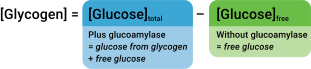
Samples that contain both glycogen and glucose require two reactions to determine the glycogen concentration. One reaction is used to measure total glucose resulting from digested glycogen plus any glucose present in the sample. The second is used to measure any glucose that was present in the sample prior to digestion. The difference in signal between the two reactions represents the contribution from glycogen in the sample. The effective digestion of glycogen into glucose monomers (≥70%) simplifies data interpretation and calculations.
Simple Assay Protocol Saves Time
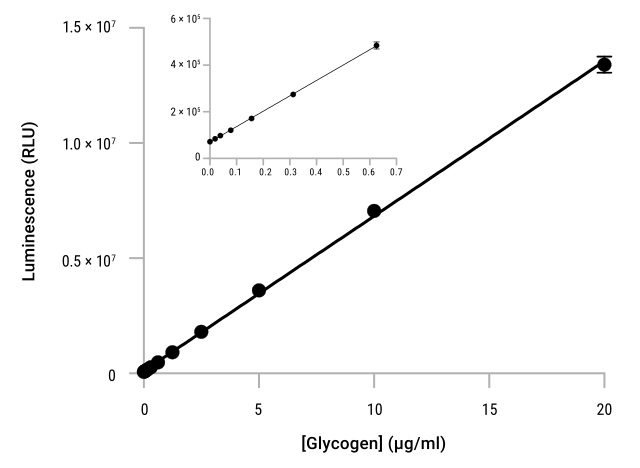
Accurately Detect the Smallest Changes in Glycogen
|
Sensitivity (S/B >5) |
0.6µg/ml |
|
|
Limit of Detection (S/N >3) |
20ng/ml |
|
|
Linear Range |
To 20µg/ml glycogen |
|
|
Maximum Assay Window (S/B) |
>150 |
|
Measure Glycogen Content of Cells in Culture
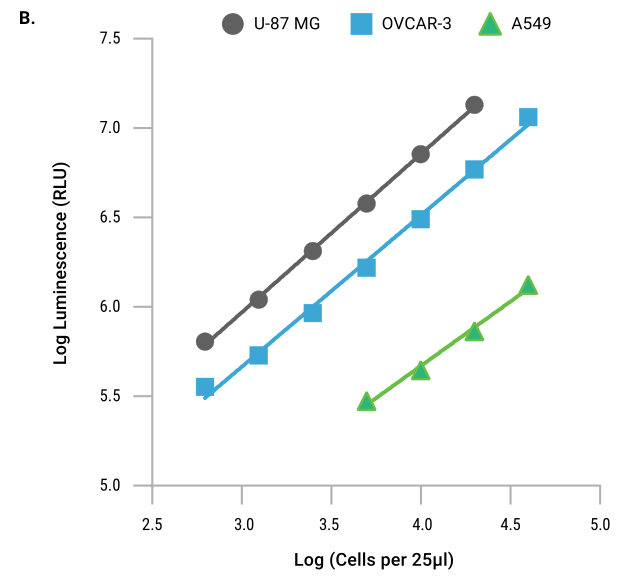
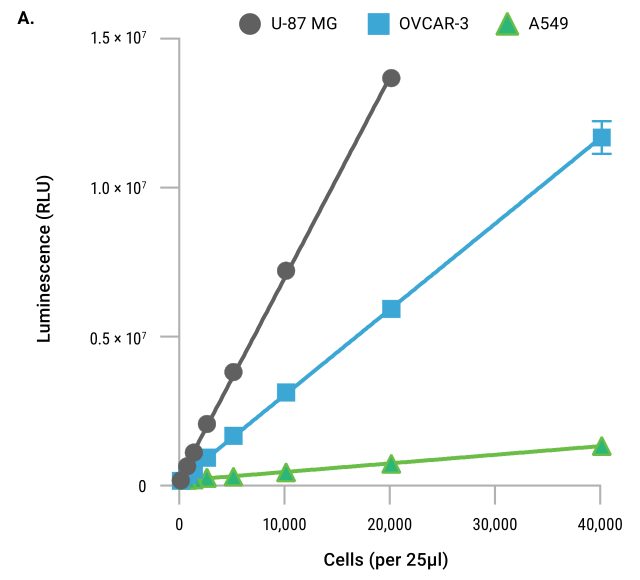
Cellular glycogen content varies greatly depending on cell type and growth conditions. The high sensitivity and wide linearity of the Glycogen-Glo™ Assay accommodate measurement of glycogen in cells, regardless of whether they have low or high glycogen levels. The data show analysis of intracellular glycogen content of three cell lines using the Glycogen-Glo™ Assay.
Do you want to learn more about our cellular energy metabolism tools and the innovative technology that powers these assays?
Protocols
Complete Protocol
Specifications
Catalog Number:
Contenido
| Item | Part # | Presentación | Concentración |
|---|---|---|---|
Reductase |
G884A | 1 × 55μl | 6mg/ml |
Reductase Substrate |
G885A | 1 × 55μl | |
Luciferin Detection Solution |
J135A | 1 × 5ml | |
NAD |
J136A | 1 × 30μl | |
Glucose |
J138A | 1 × 50μl | |
Glucose Dehydrogenase |
J140A | 1 × 200μl | |
Glucoamylase Buffer |
J403A | 1 × 3ml | |
Glucoamylase |
J404A | 1 × 25μl | |
Glycogen |
J405A | 1 × 50μl | |
0.3N HCl |
J406A | 1 × 15ml | |
Tris Buffer |
J407A | 1 × 15ml |
SDS
Search for SDSCertificado de Análisis
Use Restrictions
For Research Use Only. Not for Use in Diagnostic Procedures.Condiciones de Almacenaje
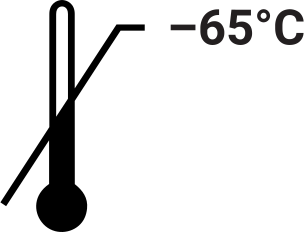
U.S. Pat. Nos. 9,273,343 and 9,951,372, European Pat. No. 2751089, Japanese Pat. No. 6067019 and other patents pending.
Contenido
| Item | Part # | Presentación | Concentración |
|---|---|---|---|
Reductase |
G884B | 1 × 275μl | 6mg/ml |
Reductase Substrate |
G885B | 1 × 275μl | |
Luciferin Detection Solution |
J135B | 1 × 50ml | |
NAD |
J136B | 1 × 275μl | |
Glucose |
J138A | 1 × 50μl | |
Glucose Dehydrogenase |
J140B | 2 × 1ml | |
Glucoamylase Buffer |
J403B | 1 × 30ml | |
Glucoamylase |
J404B | 1 × 150μl | |
Glycogen |
J405A | 1 × 50μl | |
0.3N HCl |
J406A | 1 × 15ml | |
Tris Buffer |
J407A | 1 × 15ml |
SDS
Search for SDSCertificado de Análisis
Use Restrictions
For Research Use Only. Not for Use in Diagnostic Procedures.Condiciones de Almacenaje
U.S. Pat. Nos. 9,273,343 and 9,951,372, European Pat. No. 2751089, Japanese Pat. No. 6067019 and other patents pending.
Resources
Artículos
Posters
Otros
- Blog Article: Assays for Measuring Insulin Activity
- NAFLD & NASH Liver Disease Research Tools
- Diabetes Research Tools
- Article: Bioluminescent Assay for the Quantification of Cellular Glycogen Levels
- Article: Small-molecule inhibition of glycogen synthase 1 for the treatment of Pompe disease and other glycogen storage disorders
Related Products
Productos Similares
Glucose Uptake-Glo™ Assay
Ensayo no radiactivo para medir la captación de glucosa.
J1341, J1342, J1343
Triglyceride-Glo™ Assay
Detecta los niveles de triglicéridos midiendo el glicerol que se libera de una reacción enzimática con una lipasa.
J3160, J3161
Lactate-Glo™ Assay
Ensayo bioluminiscente que detecta rápidamente el lactato a partir de diversos tipos de muestras.
J5021, J5022
Lumit® Insulin Immunoassay
Quantitatively measures insulin from cell culture or islet secretion samples using a fast, easy no-wash protocol.
W8010, W8012
Usado con frecuencia junto con
CellTiter-Glo® 2.0 Cell Viability Assay
Versión actualizada del CellTiter-Glo® Cell Viability Assay con una estabilidad del reactivo mejorada. Cuantifica la proliferación celular basándose en la detección de ATP.
G9241, G9242, G9243
RealTime-Glo™ MT Cell Viability Assay
Método bioluminiscente que permite monitorizar la cinética de viabilidad de cultivos celulares durante 72 horas.
G9711, G9712, G9713
CellTox™ Green Cytotoxicity Assay
Mide los cambios en la integridad de la membrana. Monitoriza cinéticamente la citotoxicidad hasta 72 horas y además tiene capacidad multiplex.
G8741, G8742, G8743, G8731
GloMax® Discover System
Lector de microplacas de alto rendimiento para la detección de luminiscencia, fluorescencia y absorbancia.
GM3000