ROS-Glo™ Extracellular Nitric Oxide Assay

Specific, Reproducible Detection of Nitric Oxide (NO)
- Highly specific detection of extracellular NO, with no interference from other ROS
- Detection of NO in cell-based applications, including immune cells
- Simple two-reagent addition protocol with no dye washout steps gives reproducible results


Catalog Number:
Size
Catalog Number: CS3271A02
Targeted Detection of Extracellular Nitric Oxide
Nitric oxide (NO), a key reactive oxygen species (ROS), plays a critical dual role in cellular biology, serving both as a signaling molecule and as a contributor to oxidative stress. Accurately detecting NO levels is essential for understanding physiological and pathological processes. However, its extremely short half-life and rapid conversion to nitrate make direct measurement of NO difficult.
The ROS-Glo™ Extracellular Nitric Oxide Assay is a sensitive bioluminescent assay designed to overcome the stability limitations of NO, enabling sensitive and selective detection of extracellular nitric oxide in cell culture and biochemical samples. The assay utilizes an advanced bioluminescent probe that reacts specifically with superoxide, generating a proportionate light signal in just 60 minutes.
ROS-Glo™ Extracellular Nitric Oxide Assay Chemistry
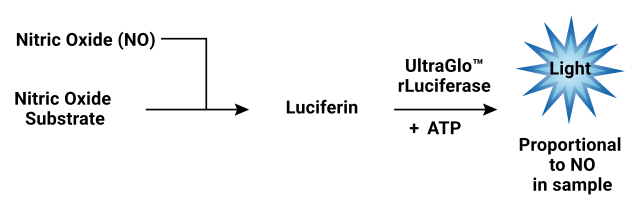
The ROS-Glo™ Extracellular Nitric Oxide Assay uses a nitric oxide substrate that reacts directly with nitric oxide to create a stable luciferin product. The subsequent addition of the luciferin detection reagent, which contains UltraGlo™ rLuciferase and required cofactors, produces light proportional to the amount of extracellular nitric oxide in the sample. Please note that a nitric oxide reference standard is not provided in the kit.
Sample compatibility: The assay is optimized for use with cells in culture. However, the NO Substrate is unlikely to cross cell membranes, so the assay readout only reflects extracellular NO levels. Other sample types could be compatible with the assay, but will need to be tested and optimized by the user.
Explore the science behind our novel nitric oxide detection method
Read the Paper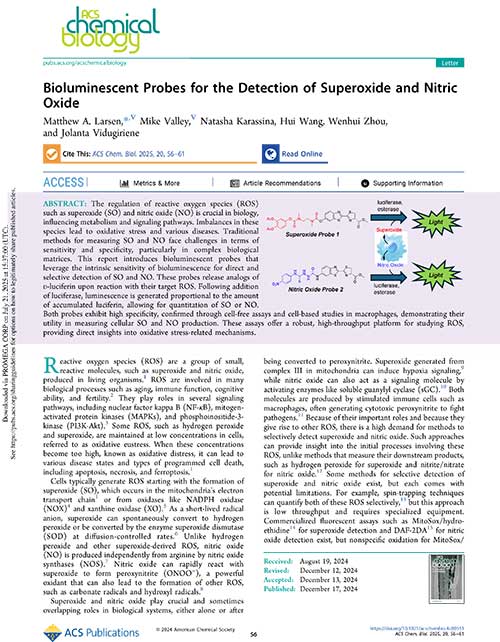
Validated Specificity: Nitric Oxide Detection and Quantification
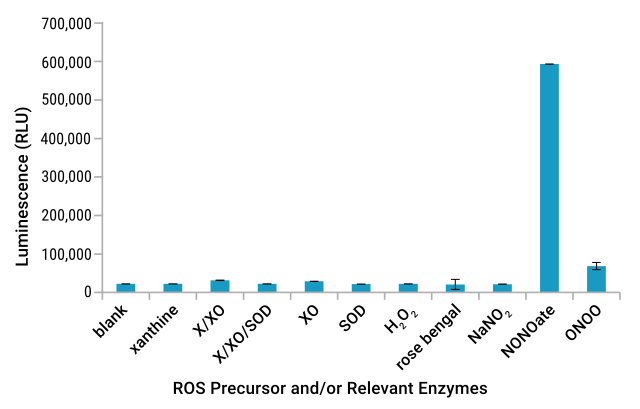
Abbreviation Key
X/XO: Xanthine + Xanthine Oxidase
X/XO/SOD: Xanthine + Xanthine Oxidase + Superoxide Dismutase
XO: Xanthine Oxidase alone
SOD: Superoxide Dismutase alone
H2O2: Hydrogen Peroxide
Rose Bengal: Photosensitizer generating singlet oxygen upon illumination
NaNO2: Sodium Nitrite
NONOate: Nitric Oxide donor
ONOO-: Peroxynitrite
This kit does not detect nitrite or other bioactive NO derivatives that may accumulate in cells or media. For detection of nitrite, please use the Griess Reagent System.
Nitric Oxide Detection from Macrophages
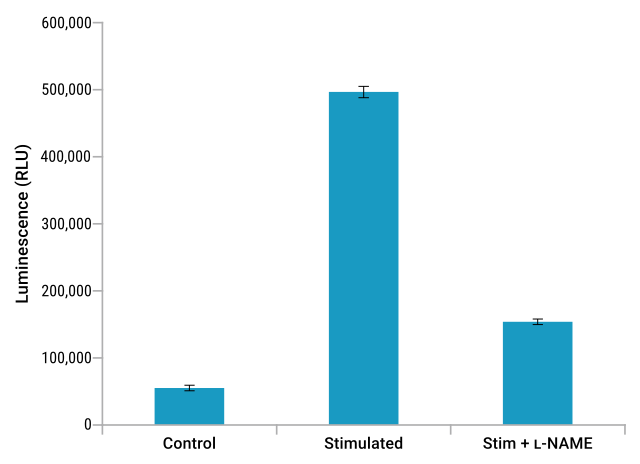
RAW264.7 cells (20,000 cells) were stimulated with 0.5μg/ml LPS and 20ng/ml IFNγ for 24 hours, inducing NO production. Some wells were also treated with 1mM l-NAME (nitro-l-arginine methyl ester) to inhibit NO production. ROS-Glo™ Extracellular Nitric Oxide Assay was utilized to detect NO in the cell supernatant following treatments.
Biochemical Analysis of NO Production
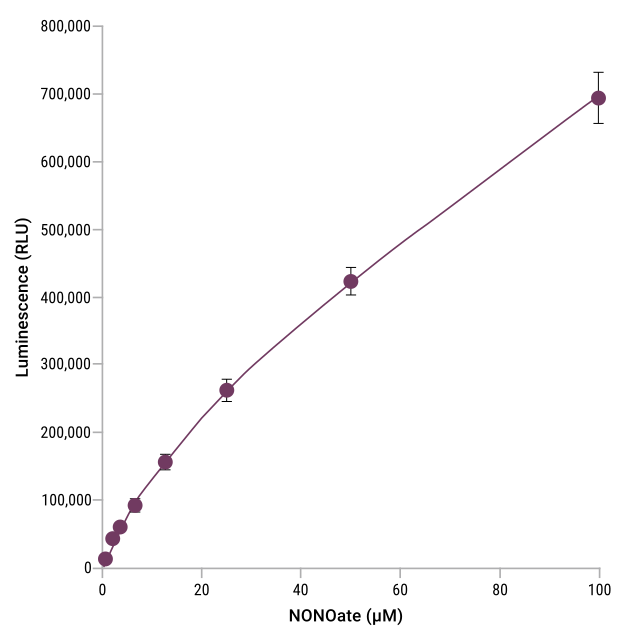
Titration of diethylamine NONOate from 0–100µM. ROS-Glo™ Extracellular Nitric Oxide assay was used to measure NO production.
Do you want to learn more about our cellular energy metabolism tools and the innovative technology that powers these assays? Explore our metabolic activity assay portfolio.
Protocols
No protocols available
Specifications
Catalog Number:
Contenido
| Item | Part # | Presentación |
|---|---|---|
NO Substrate |
CS3271A01 | 3 × 0.4μmol |
|
Luciferin Detection Reagent |
V859A | 1 × 1 each |
Reconstitution Buffer with Esterase |
V144A | 1 × 10ml |
U.S. Pat. Nos. 9,273,343 and 9,951,372, European Pat. No. 2751089, Japanese Pat. No. 6067019 and other patents pending.
Related Products
Productos Similares
ROS-Glo™ H2O2 Assay
Ensayo bioluminiscente sensible que mide el nivel de H2O2 en cultivos celulares.
G8820, G8821
Griess Reagent System
Mide el nitrito, un mensajero fisiológico en muchos sistemas biológicos.
G2930
GSH/GSSG-Glo™ Assay
Ensayo homogéneo para cuantificar el glutatión total y los ratios de glutatión.
V6611, V6612
GSH-Glo™ Glutathione Assay
Ensayo homogéneo y bioluminiscente para medir el glutatión.
V6911, V6912
Usado con frecuencia junto con
GloMax® Discover System
Lector de microplacas de alto rendimiento para la detección de luminiscencia, fluorescencia y absorbancia.
GM3000
Lactate-Glo™ Assay
Ensayo bioluminiscente que detecta rápidamente el lactato a partir de diversos tipos de muestras.
J5021, J5022
Lumit® IFN-γ (Human) Immunoassay
Mide cuantitativamente el IFN-γ liberado en muestras de cultivos celulares mediante un protocolo sencillo y sin lavado.
W6040, W6042, W6041, W134A-C
Lumit® IL-1β Human/Mouse Immunoassay
Cuantifica la activación del inflamasoma mediante la medición de la IL-1β liberada utilizando un protocolo sencillo y sin lavado.
W6010, W6011, W6012, W7010, W7011, W7012, W116A-C, W119A-C
